


Knee Replacement with the VELYS™ Robotic-Assisted Solution
Available at Rivers Health
Knee Replacement with the VELYS™ Robotic-Assisted Solution
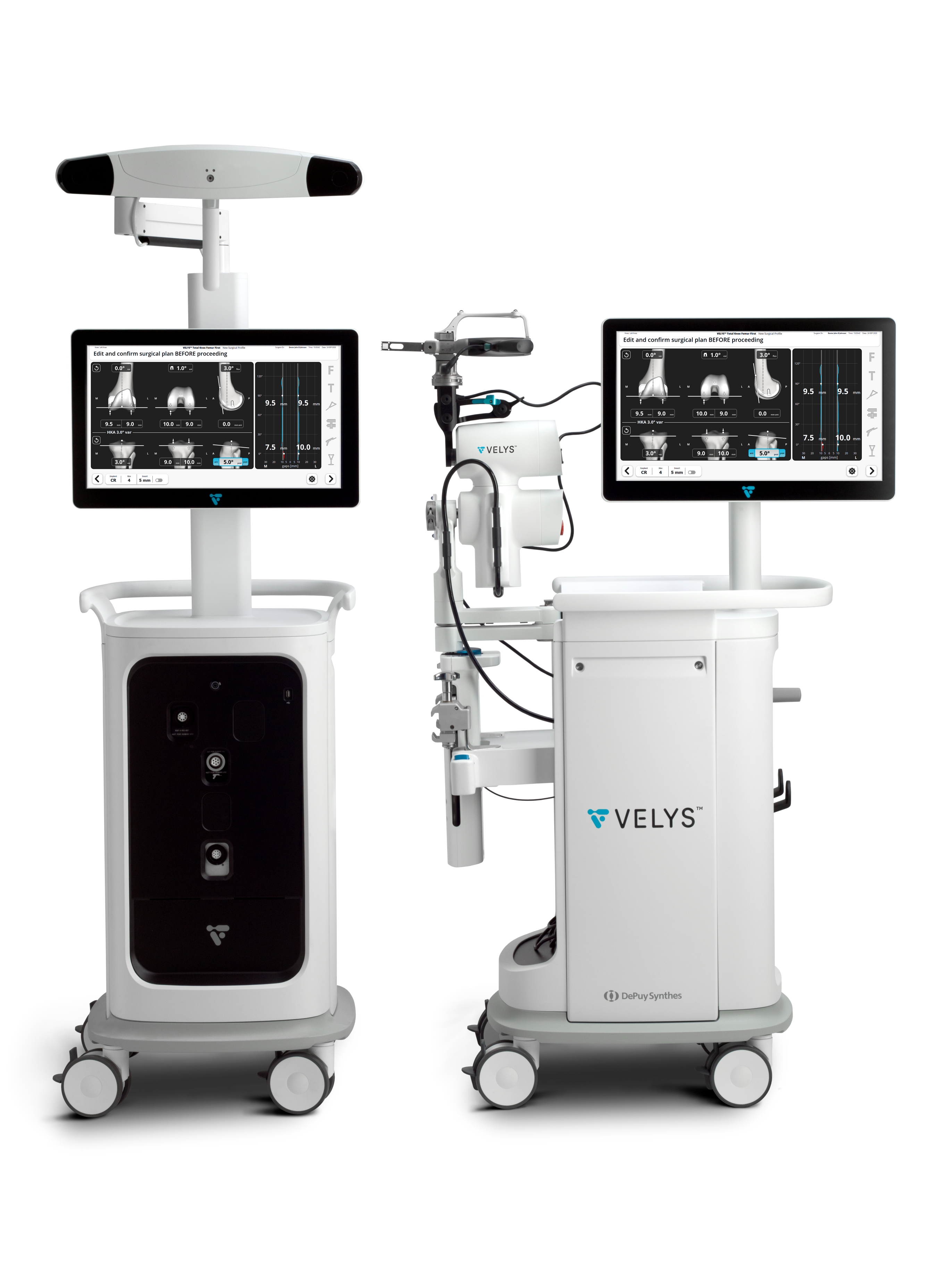
A knee replacement is a procedure performed to fix the damaged parts of a knee with different types of implants. Every knee is different, as is every patient requiring a knee replacement procedure. Advanced technology like robotic-assisted devices can help your surgeon perform a precise knee replacement surgery personalized for your specific anatomy.1,2 The VELYS™ Robotic-Assisted Solution is designed for digital precision, which may improve early patient outcomes following total knee replacement surgery.2
How does the VELYS Robotic-Assisted Solution work
The VELYS Robotic-Assisted Solution uses a variety of advanced technologies to provide the surgeon with the information and tools they need to perform an accurate and precise knee replacement.1,2
This solution is designed to:
- Aid your surgeon by accessing state-of-the-art technology to provide insights for real-time decision making.1,2
- Help your surgeon remove the damaged bone with accuracy.1,2 This robotic-assisted device does not move or operate on its own. Your surgeon remains in control of the surgery and uses the system for guidance.
- Gather the necessary data about your knee’s unique anatomy through the use of an infrared camera and optical trackers
Which implant will be used with the VELYS Robotic-Assisted Solution?
For total knee replacement, the VELYS Robotic-Assisted Solution works exclusively with the ATTUNE™ Knee System. The ATTUNE Knee System has been provided to over 2 million patients worldwide4 and is designed to deliver a greater range of motion and faster recovery, so you can get back to living the life you want to live.5,6 For patients who may be a candidate for partial knee replacement, the VELYS Robotic-Assisted Solution works exclusively with the SIGMA™ HP Partial Knee System, which has been received by nearly 130,000 patients since it became clinically available in 2008.7
How does robotic-assisted knee replacement compare to a traditional knee replacement?
The goals of robotic-assisted knee replacement and traditional or manual knee replacement are the same:
- Restore the knee joint by removing the damaged bone and cartilage
- Replace the damaged surfaces with a knee implant
The primary difference between the two approaches to knee replacement are the enabling technologies that aid the procedure.
What are the benefits of using robotic-assisted technology?
There are several potential benefits to using this technology for your knee replacement. During your procedure, the technology will gather details and data related to your knee to help find a favorable implant fit. Additionally, robotic-assisted technology may allow your surgeon to perform a knee replacement tailored to you, while providing both precision and accuracy during your procedure.1,2
Robotic-assisted technology may deliver*:
- A greater range of motion (how well you can bend and flex your knee after surgery)8,9
- Less pain compared to traditional methods2,8
- Faster recovery times (reduced length of hospital stay, hospital re-admissions, and health visits)2,10
For appointments and referrals, call Marshall Orthopaedics - Point Pleasant at 304.675.2781.

Saygin Kamaci, MD
Clinical Interests:
Locations:
- Marshall Orthopaedics - Point Pleasant 304.675.2781

Marshall Orthopaedics - Point Pleasant
Rivers Health
2520 Valley Drive
Suite 211
Point Pleasant, WV 25550
Phone: 304.675.2781
Important Safety Information
As with any medical treatment, individual results may vary. The performance of knee replacements depends on age, weight, activity level and other factors. There are potential risks, and recovery takes time. People with conditions limiting rehabilitation should not undergo this surgery. Only an orthopaedic surgeon can determine if knee replacement surgery is an option for you.
* Findings based on studies conducted across multiple robotic-assisted total knee replacement systems.
References:
-
Doan GW, Courtis RP, Wyss JG, Green EW, Clary CW. Image-Free Robotic-Assisted Total Knee Arthroplasty Improves Implant Alignment Accuracy: A Cadaveric Study. J Arthroplasty. 2022;37(4):795-801. doi:10.1016/j.arth.2021.12.035
-
Clatworthy M. Patient-Specific TKA with the VELYS™ Robotic-Assisted Solution. Surg Technol Int. 2022;40:315-320. doi:10.52198/22.STI.40.OS1561
-
Ren Y, Cao S, Wu J, Weng X, Feng B. Efficacy and reliability of active robotic-assisted total knee arthroplasty compared with conventional total knee arthroplasty: a systematic review and meta-analysis. Postgrad Med J. 2019;95(1121):125-133. doi:10.1136/postgradmedj-2018-136190
-
Johnson & Johnson and its affiliates. ATTUNE™ Knee System Unit Sales 2023.
-
Hamilton WG, Brenkel IJ, Barnett SL, et al. Comparison of Existing and New Total Knee Arthroplasty Implant Systems From the Same Manufacturer: A Prospective, Multicenter Study. J Am Acad Orthop Surg Glob Res Rev. 2021;5(12):e21.00136. Published 2021 Dec 15. doi:10.5435/JAAOSGlobal-D-21-00136
-
van Loon C, Baas N, Huey V, Lesko J, Meermans G, Vergroesen D. Early outcomes and predictors of patient satisfaction after TKA: a prospective study of 200 cases with a contemporary cemented rotating platform implant design. J Exp Orthop. 2021;8(1):30. Published 2021 Apr 17. doi:10.1186/s40634-021-00347-w
-
Johnson & Johnson and its affiliates. TSM Report. SIGMA HP WW implantations YTD, 2007 - 2024. J&J MedTech Synthes Sales and Royalty Database
-
Agarwal N, To K, McDonnell S, Khan W. Clinical and Radiological Outcomes in Robotic-Assisted Total Knee Arthroplasty; The Journal of Arthroplasty 35 (2020) p. 3393-3409.
-
Morrisey ZS, Barra MF, Guirguis PG, Drinkwater CJ. Transition to Robotic Total Knee Arthroplasty With Kinematic Alignment is Associated With a Short Learning Curve and Similar Acute-Period Functional Recoveries. Cureus. 2023.
-
Alton TB, Chitnis AS, Goldstein L, et al. Resource utilization and costs for robotic-assisted and manual total knee arthroplasty - a premier healthcare database study [published online ahead of print, 2023 Mar 2]. Expert Rev Med Devices. 2023;1-9. doi:10.1080/17434440.2023.2185138